Google Quantum AI Unveils Willow Chip: Error Correction Passes Physical Threshold
Google's 105-qubit superconducting processor demonstrates that scaling code distance exponentially suppresses error rates, marking a foundational milestone toward fault-tolerant quantum computers.
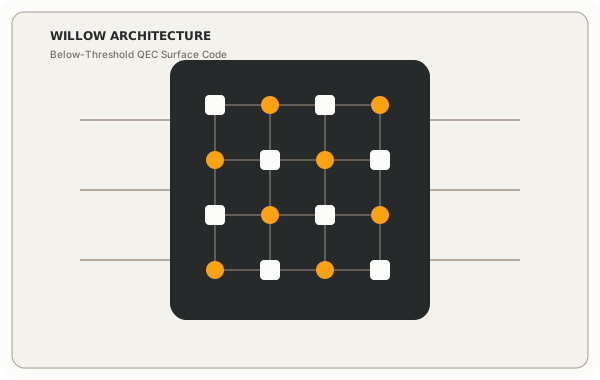
Architecture diagram of Google Willow superconducting surface code quantum processor
In a landmark paper published in Nature, Google Quantum AI introduced Willow, their state-of-the-art superconducting quantum processor featuring 105 physical qubits. The breakthrough represents the first definitive demonstration of scaling quantum error correction (QEC) where increasing the surface code distance exponentially reduces the logical error rate.
For decades, the central obstacle to practical quantum computing has been physical decoherence. Qubits are fragile; stray thermal fluctuations and microwave noise flip phases and bits. Theoretical quantum error correction postulates that physical qubits can be grouped into collective logical qubits using topological surface codes, but only if physical component fidelities sit comfortably beneath a strict “fault-tolerance threshold.”
Key Findings of the Willow Architecture
- Exponential Error Suppression: Google demonstrated that moving from code distance (17 physical qubits) to distance (49 physical qubits) and distance (105 physical qubits) halved the logical error rate with each step.
- Two-Qubit Gate Fidelity: The average two-qubit gate error was maintained at across the entire 105-qubit 2D lattice.
- Real-Time Syndrome Extraction: Readout times were cut to under 600 nanoseconds, allowing decoding algorithms to match real-time error generation without buffer overflow.
“For the first time in quantum computing history, building a larger quantum system makes it cleaner and more reliable rather than noisier. This confirms the physical viability of fault-tolerant quantum architectures.”
Dr. Hartmut Neven, Founder & Lead, Google Quantum AI
Physical Benchmark vs Classical Supercomputers
To test computational fidelity, the team ran a standard Random Circuit Sampling (RCS) benchmark on Willow. The benchmark required less than five minutes of quantum runtime.
By contrast, Google researchers calculated that reproducing the equivalent quantum state distribution using the world’s fastest classical supercomputer (Frontier at Oak Ridge National Laboratory) would require approximately:
While RCS remains an artificial benchmark designed for verification rather than commercial utility, achieving below-threshold error scaling provides the foundational blueprint for multi-thousand logical qubit processors planned before 2030.
Source & Citations
- Google Quantum AI. (2024). Quantum error correction below the surface code threshold on a superconducting processor. Nature.
- Official announcement and technical data sheets: Google Quantum AI Research.
"Learning the quantum world, one concept at a time."
Follow our daily visual breakdowns of quantum algorithms, experimental setups, and physics equations on Instagram: @quantumastra.in
Additional Research Reports
All News →
IBM Quantum Unveils Heron Processor and Updated 10-Year Roadmap to Quantum Advantage
IBM's 133-qubit Heron architecture introduces tunable couplers delivering a five-fold crosstalk reduction, alongside modular quantum communication links targeting 100,000 gates by 2029.