What Is Quantum Entanglement?
Non-local quantum correlations, Bell's inequality violations, and why Einstein called it spooky action at a distance.
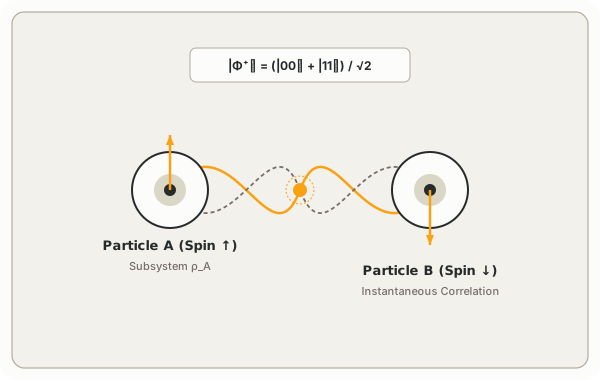
Scientific illustration of two entangled particles sharing correlated quantum spin states
Table of Contents
In 1935, Albert Einstein, Boris Podolsky, and Nathan Rosen published their celebrated EPR paper arguing that quantum mechanics was incomplete. They pointed to a bizarre consequence of the theory: two particles could be prepared in such a way that measuring one particle instantly determines the physical attributes of the other, no matter how many light-years separate them.
Einstein famously referred to this in letters to Max Born as spukhafte Fernwirkung (spooky action at a distance).
1. Defining Entanglement Mathematically
Let and denote the Hilbert spaces of two physical subsystems. The combined system lives in the tensor product space:
A composite state is separable (not entangled) if and only if it can be written as a product state of individual subsystem vectors:
If no such decomposition exists, the state is entangled.
The Four Bell States
The canonical maximally entangled two-qubit orthonormal basis, known as the Bell basis, consists of:
For the state , neither qubit possesses a definite individual state before measurement. The reduced density matrix for either particle alone is maximally mixed:
Yet their joint correlation is absolute: if Alice measures her qubit and obtains , Bob is guaranteed with probability to obtain .
2. Bell’s Theorem and the Death of Local Realism
For thirty years after EPR, physicists assumed the question of entanglement was purely philosophical. Local realists believed that “hidden variables” predetermined measurement outcomes at the moment particles were created.
In 1964, Northern Irish physicist John Stewart Bell proved that local realism makes testable statistical predictions that conflict with quantum mechanics.
For any local hidden variable theory, the Clauser-Horne-Shimony-Holt (CHSH) inequality dictates that the correlation coefficient must satisfy:
However, quantum mechanics predicts that for properly aligned polarization detector angles (), entangled pairs can yield:
Experimental Confirmation
Beginning with Alain Aspect in 1982, and culminated by the loophole-free Bell tests of 2015 by Ronald Hanson’s group in Delft, experiments have decisively demonstrated violations of Bell’s inequalities ().
The 2022 Nobel Prize in Physics was awarded to Alain Aspect, John Clauser, and Anton Zeilinger for these groundbreaking experiments.
3. Does Entanglement Allow Faster-Than-Light Communication?
No. This is formalized by the No-Signaling Theorem.
Although measurement correlations occur instantaneously, Alice cannot choose which measurement outcome she observes: she gets or randomly with probability. Bob’s local density matrix remains identically:
irrespective of whether Alice performs a measurement or not. To decode the correlation, Alice must send classical bits to Bob (via fiber optics or radio), which respects the speed of light .
References & Further Reading
- Einstein, A., Podolsky, B., & Rosen, N. (1935). Can quantum-mechanical description of physical reality be considered complete? Physical Review, 47(10), 777.
- Bell, J. S. (1964). On the Einstein Podolsky Rosen paradox. Physics Physique Fizika, 1(3), 195.
- Aspect, A., Dalibard, J., & Roger, G. (1982). Experimental test of Bell’s inequalities using time-varying analyzers. Physical Review Letters, 49(25), 1804.
"Learning the quantum world, one concept at a time."
Follow our daily visual breakdowns of quantum algorithms, experimental setups, and physics equations on Instagram: @quantumastra.in
Continue Exploring
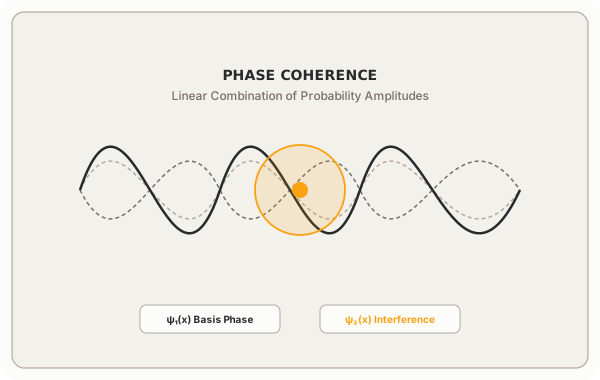
Understanding Quantum Superposition
How quantum particles exist in multiple basis states simultaneously, the mathematics of phase coherence, and the double-slit wave-particle duality.
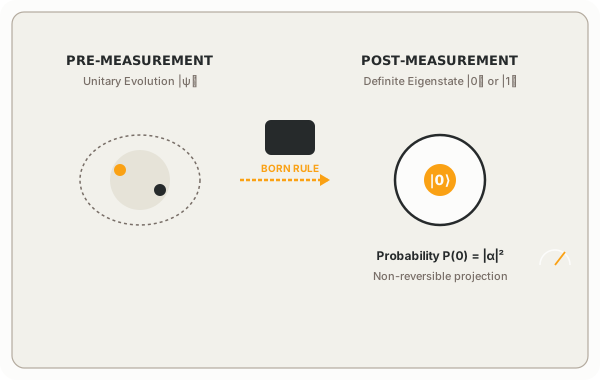
Quantum Measurement Explained
The measurement problem, the Born rule, projective vs generalized POVM measurements, and state collapse in quantum mechanics.
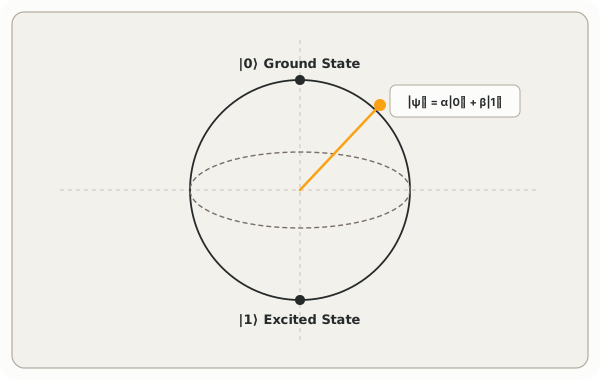
What Is Quantum Computing?
A comprehensive introduction to quantum information processing, exploring how superposition, entanglement, and quantum interference transcend classical computation limits.