Understanding Quantum Superposition
How quantum particles exist in multiple basis states simultaneously, the mathematics of phase coherence, and the double-slit wave-particle duality.
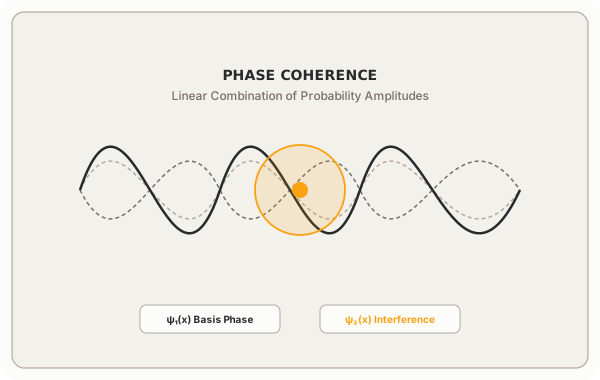
Phase coherence and wave interference representation of quantum superposition
Table of Contents
Quantum superposition is frequently mischaracterized as a state of “uncertainty” or a system “being everywhere at once.” In reality, superposition is a precise mathematical principle of linear differential equations: if state and state are valid solutions to the Schrödinger equation, their linear combination is also a valid physical state.
1. The Principle of Linear Superposition
The time-dependent Schrödinger equation:
is strictly linear with respect to the state vector . Because the Hamiltonian operator is linear, any arbitrary superposition of orthogonal eigenstates :
forms an exact physical state of the quantum system. The complex numbers are not merely probabilities; they are probability amplitudes possessing both magnitude and phase .
2. Phase Matters: Relative vs Global Phase
Consider two distinct quantum states:
Both states produce identical measurement statistics when measured along the standard computational -basis:
However, and are physically orthogonal: .
If we apply a Hadamard gate before measurement, their relative phase causes interference:
This demonstrates that phase is an active computational degree of freedom. Manipulating relative phases without triggering decoherence is the fundamental mechanism of all quantum computing algorithms.
3. Quantum Coherence and Decoherence
Why do we not observe macroscopic objects, such as chairs or humans, in superpositions of two different rooms?
The answer lies in quantum decoherence. When a quantum system interacts with its thermodynamic environment (stray thermal photons, magnetic fluctuations, cosmic rays), the system becomes entangled with the surrounding environment degrees of freedom:
Tracing out the unmonitored environment yields a reduced density matrix:
Because orthogonal environmental states have , the off-diagonal terms (the quantum coherence) decay exponentially with time constant . The system transforms from a coherent quantum superposition into a classical statistical mixture.
Key Takeaways
- Superposition is a direct consequence of the linearity of quantum state spaces.
- Probability amplitudes interfere constructively and destructively based on their relative phase.
- Decoherence is the rapid leak of phase information into the thermal environment, dictating coherence times in physical quantum hardware.
References
- Dirac, P. A. M. (1930). The Principles of Quantum Mechanics. Oxford University Press.
- Zurek, W. H. (2003). Decoherence, einselection, and the quantum origins of the classical. Reviews of Modern Physics, 75(3), 715.
"Learning the quantum world, one concept at a time."
Follow our daily visual breakdowns of quantum algorithms, experimental setups, and physics equations on Instagram: @quantumastra.in
Continue Exploring
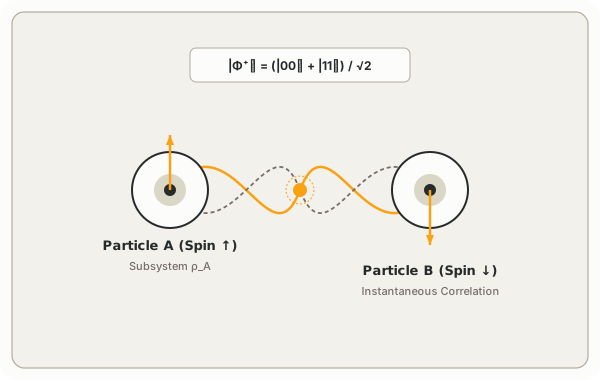
What Is Quantum Entanglement?
Non-local quantum correlations, Bell's inequality violations, and why Einstein called it spooky action at a distance.
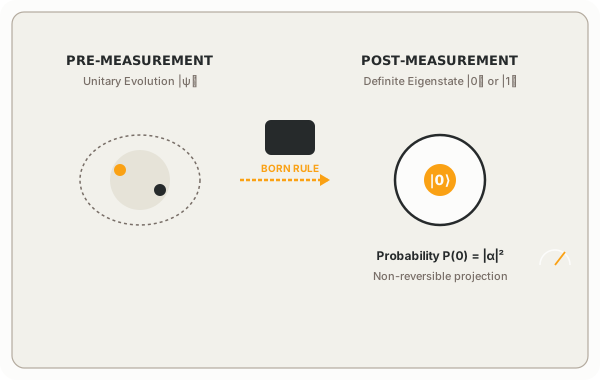
Quantum Measurement Explained
The measurement problem, the Born rule, projective vs generalized POVM measurements, and state collapse in quantum mechanics.
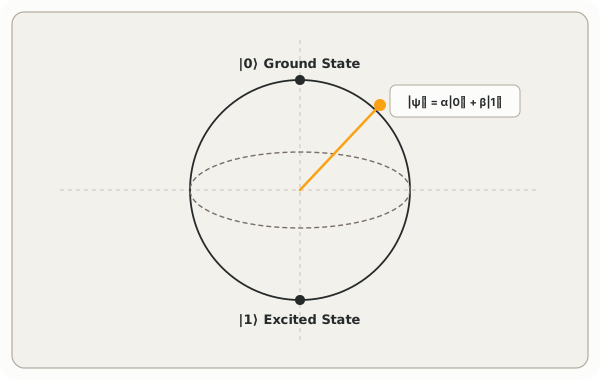
What Is Quantum Computing?
A comprehensive introduction to quantum information processing, exploring how superposition, entanglement, and quantum interference transcend classical computation limits.