Classical Bits vs Quantum Qubits
A deep comparative analysis between discrete binary architecture and continuous quantum states, exploring information density, measurement collapse, and state spaces.
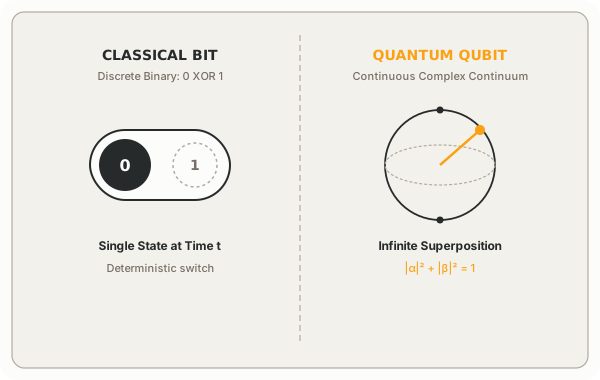
Comparison between binary digital bit toggle and continuous qubit Bloch sphere
Table of Contents
At the heart of the ongoing computational revolution lies a fundamental question: what constitutes an elementary unit of information? For nearly a century, our digital universe has rested upon Claude Shannon’s concept of the binary digit, the bit. Today, quantum information theory introduces its physical successor: the qubit.
To understand why this distinction is so profound, we must examine how classical and quantum media store, transform, and reveal information.
1. The Classical Bit: Determinism in Voltage
In semiconductor microprocessors, a bit is physically implemented using Field Effect Transistors (FETs). By measuring the electric potential across a gate:
- High voltage () represents state .
- Ground or low voltage () represents state .
At any given nanosecond, a collection of classical bits resides in exactly one state out of possibilities:
When reading a classical register, the act of observation is passive and non-destructive: copying the bit costs nothing, formalized by the ease of digital replication.
2. The Quantum Bit: Continuous Complex Amplitudes
A qubit is not a toggle switch. It is a two-level quantum mechanical system described by a state vector within a two-dimensional complex Hilbert space:
While the basis vectors and correspond to classical and , the coefficients and can take continuous values on the unit sphere:
Architectural Comparison
| Dimension | Classical Bit | Quantum Qubit |
|---|---|---|
| State Space | Discrete | Continuous 2D Hilbert space |
| Information Capacity | 1 binary value | Infinite continuous states prior to readout |
| Cloning | Trivially copied (Turing tape) | Impossible (No-Cloning Theorem) |
| Measurement | Non-destructive & repeatable | Destructive wave function collapse |
| Joint States | Cartesian product ( bits) | Tensor product space ( amplitudes) |
3. The No-Cloning Theorem
In classical programming, copying a memory register is trivial: x = y. In quantum mechanics, an unknown quantum state cannot be copied.
Formally proved by Wootters, Zurek, and Dieks in 1982, suppose there existed a unitary operator that could copy an arbitrary state onto a blank state :
Taking the inner product of both sides:
This equation has only two solutions: or . Consequently, a universal quantum copier cannot exist for non-orthogonal states.
This mathematical property guarantees unconditional security in Quantum Key Distribution (QKD), as any eavesdropper attempting to intercept and clone photons inevitably introduces detectable quantum phase errors.
4. State Representation: The Bloch Sphere
Because global phase is physically unobservable, we can parameterize any pure single-qubit state with two real parameters and :
- The north pole represents ().
- The south pole represents ().
- The equator holds equal superpositions, such as () and ().
Single-qubit quantum gates correspond directly to rigid three-dimensional rotations of the Bloch vector around coordinate axes.
References & Citations
- Wootters, W. K., & Zurek, W. H. (1982). A single quantum cannot be cloned. Nature, 299(5886), 802-803.
- Bennett, C. H., & Brassard, G. (1984). Quantum cryptography: Public key distribution and coin tossing. IEEE International Conference on Computers, Systems & Signal Processing.
"Learning the quantum world, one concept at a time."
Follow our daily visual breakdowns of quantum algorithms, experimental setups, and physics equations on Instagram: @quantumastra.in
Continue Exploring
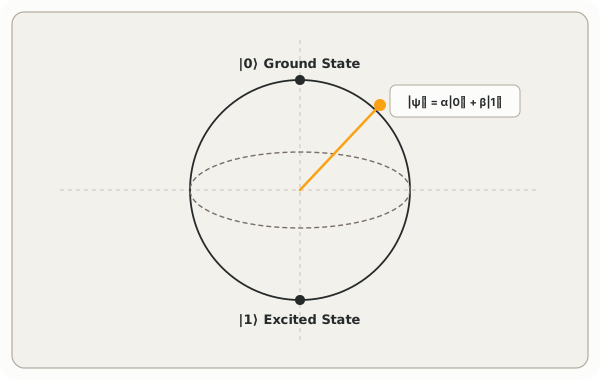
What Is Quantum Computing?
A comprehensive introduction to quantum information processing, exploring how superposition, entanglement, and quantum interference transcend classical computation limits.
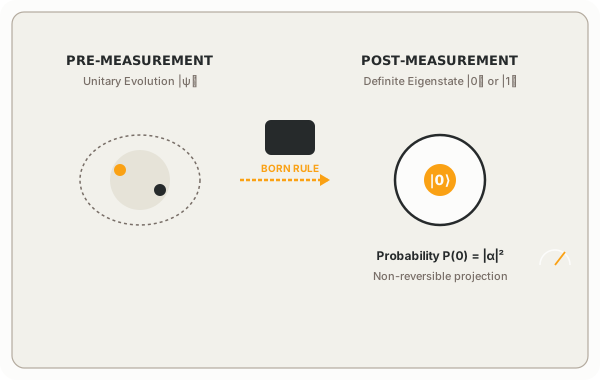
Quantum Measurement Explained
The measurement problem, the Born rule, projective vs generalized POVM measurements, and state collapse in quantum mechanics.
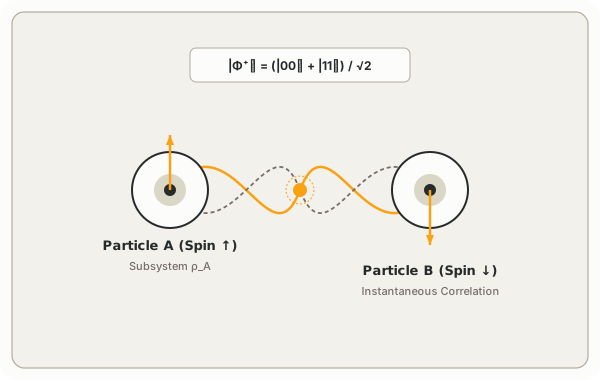
What Is Quantum Entanglement?
Non-local quantum correlations, Bell's inequality violations, and why Einstein called it spooky action at a distance.