Quantum Measurement Explained
The measurement problem, the Born rule, projective vs generalized POVM measurements, and state collapse in quantum mechanics.
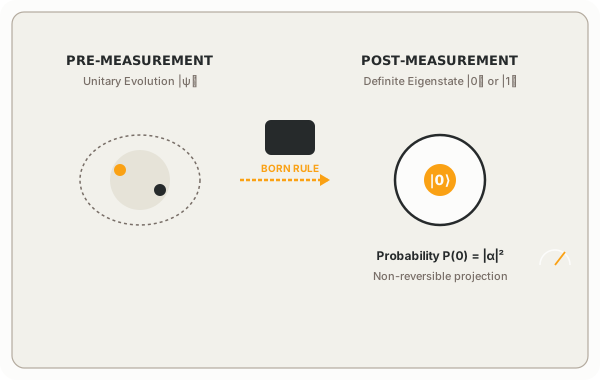
Scientific diagram of wavefunction collapse under projective quantum measurement
Table of Contents
In classical mechanics, the state of a system (its position and momentum ) exists independently of observation. An astronomer viewing Jupiter with a telescope exerts a negligible disturbance on its orbital trajectory.
In quantum mechanics, measurement is not a passive reading of an existing value. It is an irreversible physical intervention that fundamentally reshapes the state of the system.
1. Projective Measurements and the Born Rule
In the standard von Neumann formulation of quantum theory, a physical observable is represented by a Hermitian operator acting on a Hilbert space . By the spectral theorem, can be decomposed into its eigenvalues and orthogonal projection operators :
When a quantum system prepared in state is measured with respect to observable :
The Born Rule
The probability of obtaining eigenvalue is given by the squared norm of the projected state:
For a simple qubit , measuring along the computational basis yields:
State Update / Wavefunction Collapse
Immediately after the measurement registers outcome , the state collapses non-unitarily to the corresponding eigenstate:
Any subsequent measurement of observable made immediately afterward will yield the exact same outcome with probability.
2. Unitary Evolution vs Measurement: The Measurement Problem
Standard quantum mechanics contains two contradictory time evolution postulates:
- Postulate A (Isolated System): The state vector evolves smoothly, deterministically, and reversibly according to the linear unitary Schrödinger equation:
- Postulate B (Measurement): Upon interaction with an apparatus, evolution is abrupt, probabilistic, and non-unitary:
This divergence represents the Measurement Problem: where is the boundary between the microscopic quantum world and macroscopic classical measurement apparatus?
Major Interpretations of Quantum Mechanics
- Copenhagen Interpretation (Bohr, Heisenberg): Measurement constitutes an epistemic update. The wavefunction is a calculational tool rather than an ontological physical reality.
- Many-Worlds Interpretation (Everett): The universe is strictly unitary. No collapse occurs; instead, the measuring apparatus and observer become entangled with the system, branching the universal wavefunction into non-interacting decoherent branches.
- Objective Collapse Models (GRW, Penrose): The Schrödinger equation is non-linear at larger mass scales. Wavefunctions undergo spontaneous physical collapse when gravitational or mass thresholds are exceeded.
3. Generalized Measurements (POVMs)
In practical quantum computing and quantum cryptography, projective measurements are not always optimal. Often, researchers employ Positive Operator-Valued Measures (POVMs).
A POVM is a set of positive semi-definite operators satisfying the completeness relation:
The probability of outcome is given by:
POVMs enable unambiguous quantum state discrimination and optimal extraction of quantum mutual information with minimal disturbance to ancilla qubits.
References & Further Reading
- von Neumann, J. (1932). Mathematische Grundlagen der Quantenmechanik. Springer.
- Born, M. (1926). Zur Quantenmechanik der Stoßvorgänge. Zeitschrift für Physik, 37(12), 863-867.
- Everett, H. (1957). Relative state formulation of quantum mechanics. Reviews of Modern Physics, 29(3), 454.
"Learning the quantum world, one concept at a time."
Follow our daily visual breakdowns of quantum algorithms, experimental setups, and physics equations on Instagram: @quantumastra.in
Continue Exploring
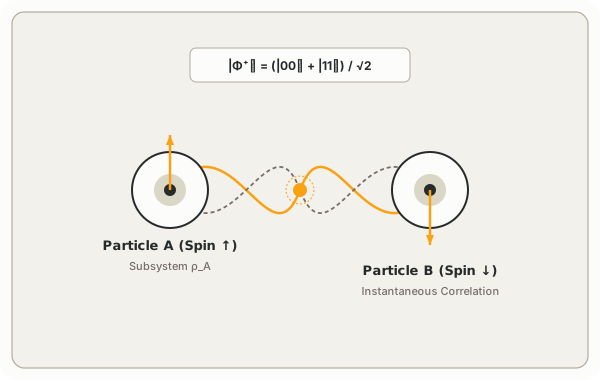
What Is Quantum Entanglement?
Non-local quantum correlations, Bell's inequality violations, and why Einstein called it spooky action at a distance.
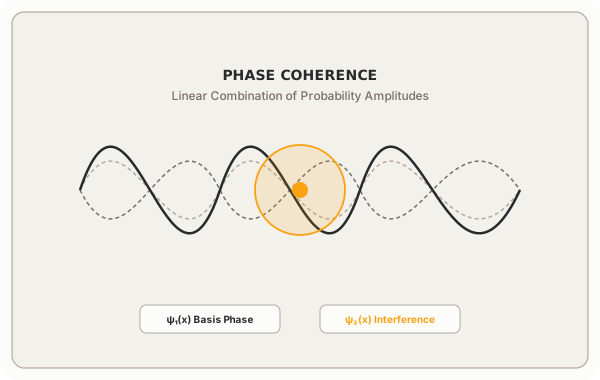
Understanding Quantum Superposition
How quantum particles exist in multiple basis states simultaneously, the mathematics of phase coherence, and the double-slit wave-particle duality.
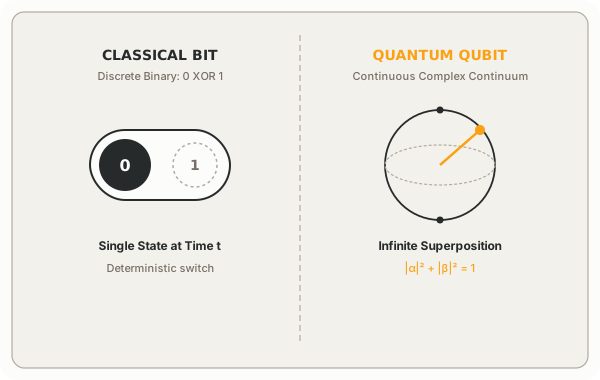
Classical Bits vs Quantum Qubits
A deep comparative analysis between discrete binary architecture and continuous quantum states, exploring information density, measurement collapse, and state spaces.